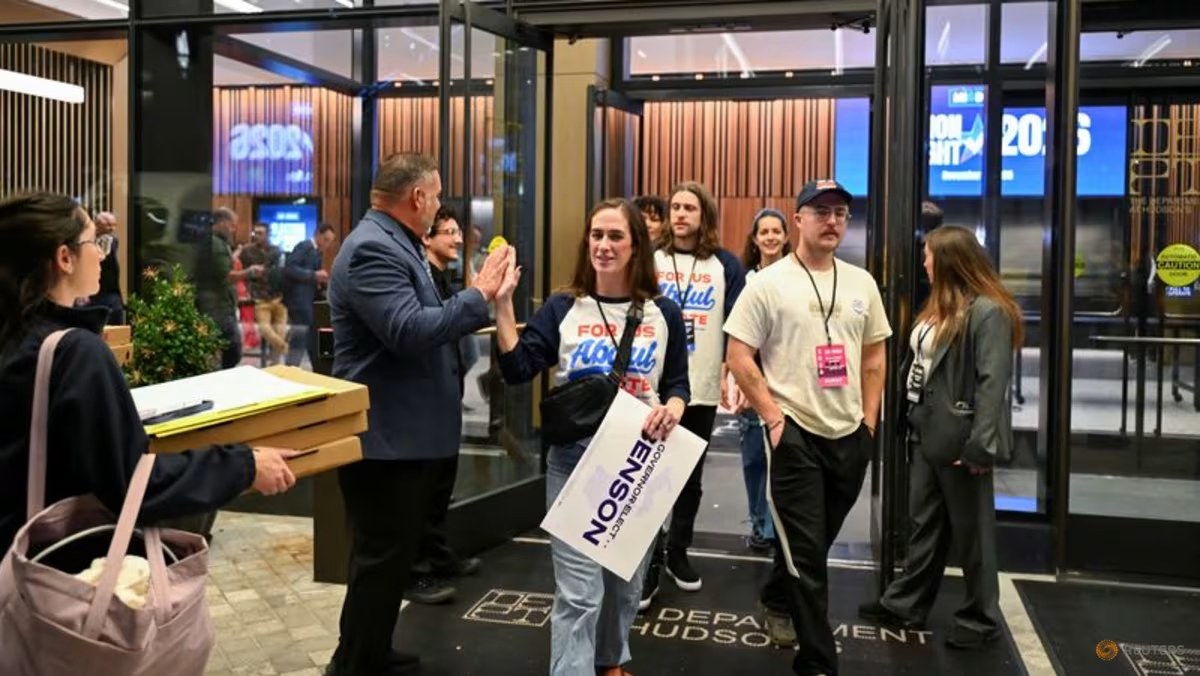
The sweeping victories by Democrats on Tuesday (Nov 3), when voters delivered a sharp rebuke to US President Donald Trump and his agenda, will intensify discussions within both parties about how to win over an electorate unhappy with the country's direction.
WASHINGTON: With the US midterms over, Democrats are turning to what could become one of their most crowded and unpredictable presidential primaries in decades, a 2028 contest likely to expose the party's divide over how to win back the White House.
No Democrat has emerged as a clear favorite in a field that could attract dozens of contenders, while Republicans have a smaller group of widely discussed candidates, led by Vice-President JD Vance and Secretary of State Marco Rubio, to succeed US President Donald Trump, who is constitutionally barred from seeking a third term.
Potential Democratic candidates, including sitting governors and senators, have spent months cultivating donors, visiting states with early nominating contests and raising their national profiles, positioning themselves for a race that strategists expect to begin in earnest now that the midterms are over.
The sweeping victories by Democrats on Tuesday (Nov 3), when voters delivered a sharp rebuke to Trump and his agenda, will intensify discussions within both parties about how to win over an electorate unhappy with the country's direction.
Despite their resounding victories on Tuesday, Democrats enter the 2028 campaign still divided over whether to tack to the centre or move further left on issues ranging from healthcare and taxes to policing and foreign policy.
Republican candidates will face a different challenge - how to distance themselves from Trump after Tuesday's repudiation of his policies. They need to broaden their appeal beyond the president's base while avoiding a break with the populist Make America Great Again (MAGA) movement that has come to define the party.
Trump, who has dominated the political landscape for a decade, may be reluctant to yield centre stage, and his continued influence with MAGA followers could complicate the path of the party's next standard-bearer.
LOOMING DEMOCRATIC BATTLE
Doug Sosnik, a Democratic strategist, said both progressives and moderates will claim vindication in their ideological approaches, ensuring an intense internal battle over the party's future as the 2028 race begins in earnest.
One of the most high-profile progressive wins came in the Michigan Senate contest, where Democrat Abdul El-Sayed easily defeated Republican Mike Rogers in a likely 2028 presidential swing state, becoming the first Muslim elected to the US Senate.
"All kinds of wings of the Democratic Party can find affirmation in the results last night," Sosnik said on Wednesday. "I don't think that anyone can, nor should they, try to contain the differences we have as a party."
The party has not had a proper debate about its philosophy and direction since 2016, when Hillary Clinton won the nomination against a spirited challenge by US Senator Bernie Sanders, a Vermont independent who describes himself as a democratic socialist, Sosnik said.
Several potential candidates have either acknowledged considering a White House run or declined to rule one out. Most spent the final weeks of the midterm campaign stumping for fellow Democrats in early nominating states such as Nevada, New Hampshire and South Carolina.
They include former Vice-President Kamala Harris, who lost to Trump in 2024, Governors Gavin Newsom of California and Andy Beshear of Kentucky, former Transportation Secretary Pete Buttigieg, and US Representative Alexandria Ocasio-Cortez of New York, a leading progressive voice.
Reuters contacted representatives for nine of the party's most prominent potential contenders. None confirmed a 2028 run.
Nine days after the Nov 3 elections, several prospective Democratic candidates, including Buttigieg and another progressive, US Representative Ro Khanna of California, are scheduled to attend a gathering in Denver hosted by Majority Democrats.
The group, backed largely by moderate Democrats and billionaire donor Steve Mandel, advocates for younger party leaders and a party platform that is more centrist.
US Representative Jake Auchincloss of Massachusetts, the group's chair, said the event is meant to spark a debate about the party's future before the 2028 race takes shape, and lay out a positive agenda for what the party is for, rather than just being anti-Trump.
Scott Ferson, a Democratic strategist, said the party's presidential primary could attract a huge number of candidates. "There are at least 30 Democrats who are saying to people close to them, 'Do you think I should run?'" Ferson said.
REPUBLICANS IN TRUMP'S SHADOW
By contrast, Republican 2028 hopefuls have been more guarded, mostly staying in Trump's shadow and deferential to him.
That could now change after Tuesday night's rout in which voters expressed deep dissatisfaction with Trump's handling of the economy and foreign policy and demanded more action against government corruption.
Vance is in a particularly difficult position, said Matt Dole, a Republican strategist. Vance has less freedom than other potential 2028 Republican contenders to put daylight between himself and Trump because he is vice president, a role that traditionally involves defending the president and his policies.
"Vance just doesn't have the wiggle room that somebody else in the cabinet has, who can resign," Dole said.
Still, Vance acknowledged on Wednesday that the war in Iran, which Trump launched in February and is deeply unpopular among Americans, had cost Republicans the election. That, however, did not represent a clear break with Trump, who made a similar acknowledgement on Tuesday night.
Whoever emerges within the Republican Party as its new standard-bearer will face the task of keeping Trump's MAGA base onside while rebuilding the broader coalition that powered his 2024 victory. Exit polls on Tuesday showed that key constituencies of that coalition, including younger voters, Hispanics and some Black men, had deserted Republicans.
Vance has said there is "a chance" he will not run, citing family considerations, while Rubio has said he has "no plans at this time" to seek the presidency.
Florida Governor Ron DeSantis, who unsuccessfully sought the Republican presidential nomination against Trump in 2024, has declined to rule out another White House bid.
Other Republicans viewed as potential candidates include Arkansas Governor Sarah Huckabee Sanders and US Senator Ted Cruz of Texas.