Will the Fed Ease AI and Oil Anxiety?
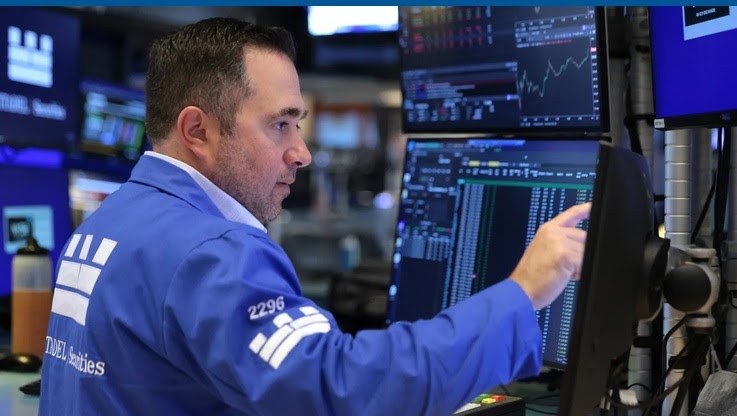
The Dow slid on Friday as a sell-off in tech in the prior session shifted to other areas of the market and U.S. oil prices topped $100 a barrel amid rising fears that the U.S.-Iran conflict would flare up again.
The Dow Jones Industrial Average dropped 652.82 points, or 1.23%, to settle at 52,215.16, while the S&P 500 slipped 0.52% to 7,623.68. The Nasdaq Composite lost 0.21% to close at 25,955.34.
More defensive stocks came under pressure on Friday, with the consumer staples, utilities and healthcare sectors all lower. Dow component American Express fell more than 3% after announcing it was cutting about 5% of its global workforce, citing the need to “prepare for AI.” Caterpillar also edged down about 2%, while Goldman Sachs lost more than 1%, adding pressure to the 30-stock index.
On Thursday, many technology stocks had pulled back as traders assessed the impact of outsized corporate borrowing and rising rates on AI and other tech names. Microsoft ticked higher on Friday. However, chip stocks such as Micron Technology and Advanced Micro Devices made a stronger move, with gains of nearly 3% and almost 2%, respectively.
“For the last two weeks, investors have been sprinting from tech stocks and data center beneficiary stocks to safe stuff, and eventually, you run out of people willing to do that sprint, and that’s what today looks like and feels like,” Jed Ellerbroek, portfolio manager at Argent Capital Management, told CNBC.
Ellerbroek added that tech companies’ earnings have proven strong this season, giving investors a reason to embrace tech stocks and focus less on emotion-based flights to safety.
“Emotion and fear play a really big role,” the investor said. But, “we’ve gotten a few tech companies’ [latest quarterly financial reports] and their earnings results have been good.”
The 10-year Treasury yield was at around 4.999%, up more than 4 basis points on the day. The benchmark yield had fallen below the key 5% level on Thursday for the first time in a month as investors grew cautious about the massive borrowing that is underway to finance the building of AI data centers.
Oil prices also rose on Friday, further pressuring stocks. West Texas Intermediate futures were up 3.8% to settle at $103.27 per barrel. Brent crude prices rose 3.1% to end the session at $116.72 for the highest settle since April. The gains follow reports that the U.S. and Israel may be drawing up plans for renewed attacks on Iran as part of the regional war that started in late February. Iran has countered that it is prepared to strike back as well.
On the week, the S&P 500 lost 0.5%, and the Nasdaq shed 0.7%. The Dow gained 0.4% in the period.
Rich Asplund of Barchart also reports that stocks were undercut by oil prices and continued AI anxiety:
The S&P 500 Index ($SPX) (SPY) fell by -0.52% on Friday, the Dow Jones Industrial Average ($DOWI) (DIA) fell by -1.23%, and the Nasdaq 100 Index ($IUXX) (QQQ) was unchanged. December E-mini S&P futures (ESZ26) fell -0.48%, while December E-mini Nasdaq futures (NQZ26) rose +0.08%.
The US stock market remained on the defensive Friday after Thursday’s sharp risk-off sell-off, which saw the S&P fall -1.2% and the Nasdaq 100 fall -2.9%. Investors dumped chip and AI-related stocks on Thursday as anxiety continues about whether the AI theme will pan out from a profitability standpoint. However, a partial recovery in chip stocks Friday helped to support the Nasdaq 100 index.
Higher oil prices weighed on stocks again Friday, with WTI crude oil prices rising by more than +4% in post-close trading. Oil prices rallied sharply on Thursday and Friday on worries about persistent Houthi attacks on Saudi Arabia and increased speculation about whether the US and Israel will launch new military attacks on Iran and/or the Houthis after next week’s Israeli election and the November 3 US election. The New York Times reported Thursday that the US and Israeli militaries have developed specific plans for renewed military strikes against Iran after the US and Israeli elections, although the report said President Trump has not yet approved those plans.
Meanwhile, President Trump’s Ambassador to the UN, Mike Waltz, told the Financial Times that the US is preparing for a protracted struggle with Iran and could still be mired in a stalemate a year from now. He added that the US Navy can maintain its blockade of Iranian ports for the “foreseeable future” and the administration is tightening economic pressure on Tehran.
The preliminary Oct S&P US manufacturing PMI rose +0.1 to 56.0, stronger than expectations for a -0.4 point decline to 55.5. The preliminary Oct S&P US services PMI fell by -0.9 to 57.9, which was slightly weaker than expectations for a -0.8 point decline to 58.0.
The final-Oct University of Michigan US consumer sentiment index was revised higher by +1.7 points to 48.0 from the preliminary 46.3, stronger than market expectations for an unrevised 46.3. However, the Oct index of 48.0 was down by -0.1 point from September’s report of 48.1 and posted a 5-month low.
Stocks are supported by the prospect of solid quarterly earnings. According to data compiled by Bloomberg Intelligence, Q3 S&P 500 earnings are expected to climb by +25% from a year earlier, up from a July estimate of 22%. As of Friday, 120 of the S&P 500 companies have reported results, with 80% beating estimates.
Markets are discounting a 9% chance of a +25 bp Fed rate hike at next week’s FOMC meeting on October 27-28.
Overseas stock markets closed mixed on Friday. The Euro Stoxx 50 closed down -0.31%. China’s Shanghai Composite closed up +0.89%, reversing part of Thursday’s loss of -1.48%. Japan's Nikkei-225 Stock Average closed down -0.34%, adding to Thursday’s loss of -2.65%.
December 10-year T-notes (ZNZ6) fell -10.5 ticks, following Thursday’s sharp rally of +1-07/32 points. The 10-year T-note yield rose +4.6 bp to 4.999%, retracing about a third of Thursday’s -16 bp plunge.
T-note prices on Friday fell back on some long liquidation after Thursday’s sharp rally, which was sparked by safe-haven demand tied to the sharp sell-off in stocks and fears that the US might soon resume military attacks on Iran.
Bearish factors for T-note prices on Friday included higher oil prices and a +1.2 bp rise in the 10-year breakeven inflation expectations rate.
European government bond yields rose. The 10-year German bund yield rose +1.1 bp to 3.345%. The 10-year UK gilt yield rose +3.1 bp to 5.356%.
Markets are discounting a 3% chance of a +25 bp ECB rate hike at the ECB’s next meeting on October 29.
The Magnificent Seven all closed lower on Friday, except for Microsoft (MSFT), which closed up +0.7%. Meta (META) closed -1% lower, adding to Thursday’s loss of -7.0% that was tied to concern about its huge bet on AI. Tesla (TSLA) fell -0.6%, adding to Thursday’s loss of -3.2% that was tied to its mixed earnings report Wednesday afternoon.
SpaceX (SPCX) rallied +1.9% on Friday after Bloomberg reported late Thursday afternoon that the company is in talks with at least one major cellular infrastructure company to secure access to at least 80,000 cell towers to fulfill its ambition of becoming the fourth major wireless company. Cell tower companies rallied on the news, with Crown Castle (CCI) rallying +9.1% and American Tower Corp (AMT) rallying +4.1%. Meanwhile, wireless carriers fell on the possible entry of another major cellular player, with AT&T (T) and T-Mobile (TMUS) both falling about -8%.
Chip stocks are recovered somewhat on Friday, with the iShares Semiconductor ETF (SOXX) rising +0.5% after its -6.8% plunge on Thursday. Micro Technology (MU), GlobalFoundries (GFS), and Marvell (MRVL) closed up more than +2%.
Crypto stocks closed mostly lower, even though Bitcoin on Friday recovered by +0.2%, a small part of Thursday’s -4.1% sell-off. Galaxy Digital (GLXY), Bullish (BLSH), and Mara Holdings (MARA) fell by more than -3%.
American Express (AXP) fell more than -3% after reporting that transactions on credit cards and other products in the latest quarter were below the market consensus and that revenue of $454 billion was slightly below the consensus. However, Amex boosted its full-year earnings guidance, and Q3 adjusted earnings of $4.68 per share were above the consensus of $4.49.
Norwegian Cruise (NCLH) fell -2.8% after a rating downgrade by JPMorgan to underweight from neutral and a price target cut to $11 from $13.
SLB (SLB) rallied more than +7% after the oilfield services company, previously named Schlumberger, reported above-consensus earnings as Middle East activity improved.
Verizon Communications Inc (VZ), Liberty Live Holdings Inc (LLYVA), Whirlpool Corp (WHR), Simpson Manufacturing Co Inc (SSD), Welltower Inc (WELL), Amkor Technology Inc (AMKR), Public Storage (PSA), Rambus Inc (RMBS), Brown & Brown Inc (BRO), Principal Financial Group Inc (PFG), Cincinnati Financial Corp (CINF), Alexandria Real Estate Equitie (ARE), Brixmor Property Group Inc (BRX), Cadence Design Systems Inc (CDNS), Sun Communities Inc (SUI), Nucor Corp (NUE).
It was another "AI anxiety" week where the AI trade got clobbered again.
Here are the worst-performing US large-cap stocks this week (full list here):
You will see a lot of semis EMS stocks got dinged hard this week. Names like Flextronix, Celestica, KLA-Tencor. Data center builders like Bloom Energy also got hit hard.
And here are the best-performing US large-cap stocks this week (full list here):
Among them, I noted cybersecurity stocks like Zscaler performed very well, as did software names like Servicetitan and Check Point Software (all of them bouncing back lately after underperforming for most of the year).
In terms of sectors, energy and Healthcare outperformed other sectors this week:
So what should we expect next week? Important big tech earnings (Google, Microsoft, Amazon and Apple) and a big Fed meeting where it is widely expected the Fed will stay put on rates before midterms.
Thus far, October has been a RISK OFF month and if you look over the last month, Energy, Staples, Utilities and Healthcare have outperformed all sectors, especially tech, which has been battered by AI fears:
Will this "defensive" trend continue in November, December, January, and February?
I wouldn't bet on it. I see a vicious bounce in the works for all the AI-related stocks that have been clobbered this month as well as many biotech stocks I personally trade.
That is my two cents on these markets. Take it or leave it but I wouldn't read too much into Ken Griffin being worried about an AI bubble (Citadel is profiting immensely off the volatility), and I certainly wouldn't extrapolate what is happening in markets over the last two weeks well into the future.
Below, the CNBC Investment Committee reveals its strategy as sentiment seems to be shifting in the market.
Also, Citadel Securities founder Ken Griffin spoke at the Bloomberg Future of Global Markets conference, sharing his perspective on AI's profound impact on the future of work, why investors are becoming more discerning about AI investments and how even amid market bubbles, transformative technologies can give rise to companies that reshape the global economy.