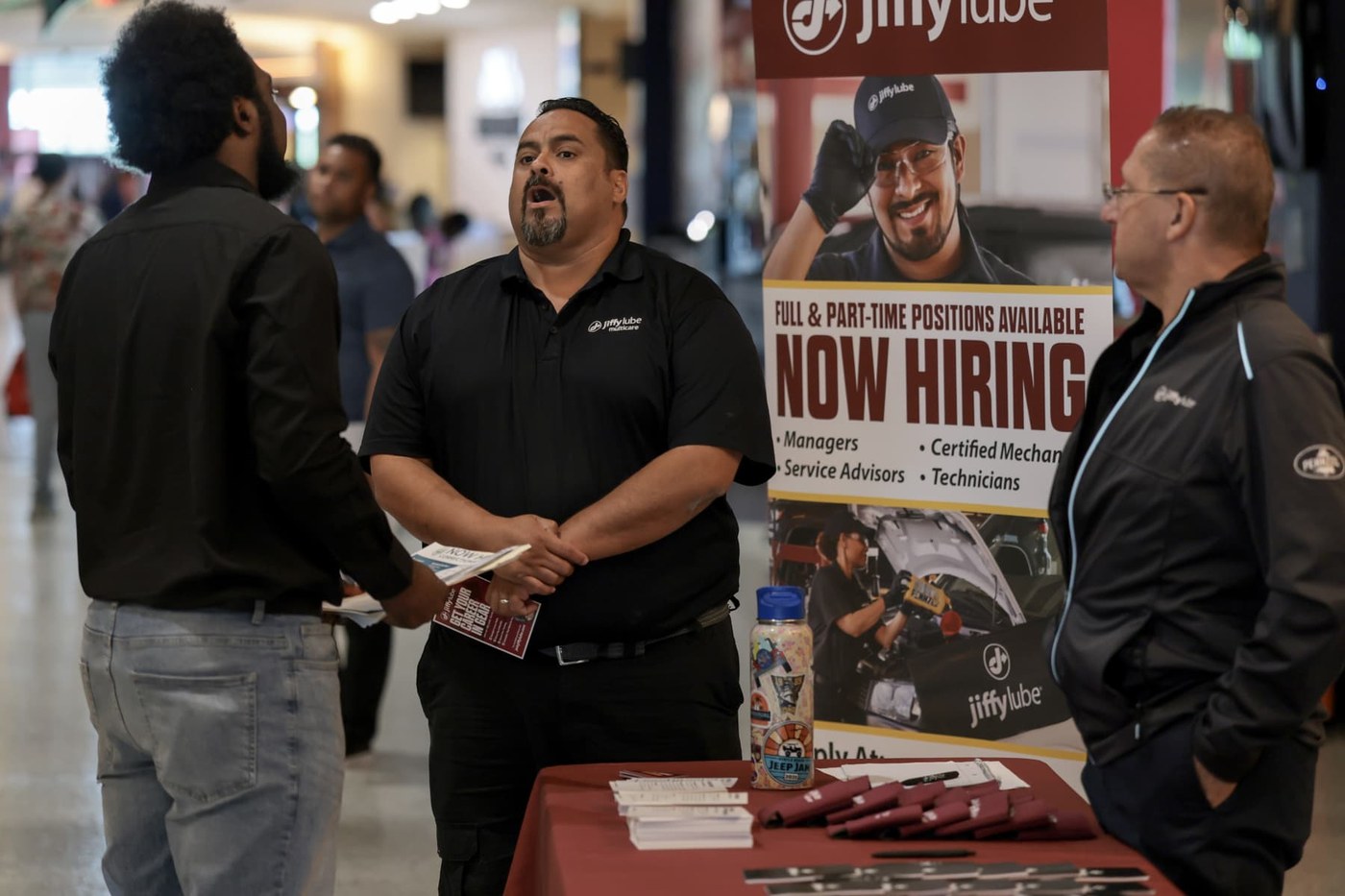
Lingering questions over the state of the U.S. labor market could be answered Friday when the Bureau of Labor Statistics presents its nonfarm payrolls count for September.
Wall Street is looking for job growth of 84,000 to close out the summer, with the unemployment rate holding at 4.1%, according to the Dow Jones consensus.
While the top-line payrolls number represents a downshift from the pre-2025 trend, the jobless rate, which Federal Reserve officials watch more closely, is around a level indicating full employment.
The September release follows a surprisingly strong gain of 162,000 in August, which also saw upward revisions to prior months.
Fed officials likely will be looking to the number to confirm labor market strength while they simultaneously turn the balance of their attention to the more nettlesome inflation picture.
"In the labor market, a broad range of data indicates that conditions have stabilized," Fed Vice Chairman Philip Jefferson said in a speech Thursday. "While job creation has been somewhat volatile, payroll gains have broadened to many sectors in recent months, which is encouraging. Layoffs have remained low, and job openings have moved a bit higher on net."
Even with a solid jobs picture, Fed commentary this week has shifted market expectations for a rate hike near the end of October.
New York Fed President John Williams remarked earlier in the week that "there is no need for urgency" when policymakers weigh whether to follow up on September's quarter percentage point rate hike with another increase.
"On the employment side of [the Fed's twin goals of full employment and stable prices], the data show that the labor market continues to be solid — and has even strengthened a bit on the margin," Williams said.
Markets subsequently sharply reduced the odds for a hike at the Oct. 27-28 meeting and see a move much more likely in December.
Slow but steady
Central to the argument that the Fed needs to focus on inflation but doesn't need to be in a hurry for another hike is the stable if unspectacular labor picture.
Payroll growth has averaged 80,000 a month in 2026 but has been erratic, from the loss of 156,000 jobs in February to growth of 214,000 the following month, with hits and misses in between.
Wage growth also has moderated, with average hourly earnings expected to show a 3.1% year-over-year increase in September, down from around 4% at the start of the year. Fed officials have emphasized that wages are not a significant source of inflation, with the lack of evidence of a wage-price spiral an important distinction when calibrating policy.
Still, there are worries over labor market conditions.
The most recent Glassdoor survey shows employee confidence fell to a record low in September, the third time that has happened this year. Daniel Zhao, the job site's chief economist, said the concerns come as "anxiety around job security, economic uncertainty and inflation mount."
Workers also cite fear of artificial intelligence.
However, layoffs remain low, with the latest data showing that first-time claims for unemployment insurance edged down to 197,000 last week. Job placement firm Challenger, Gray & Christmas reported Thursday that layoffs in September were off 18% from August and 20% from the same period a year ago.
"Job openings are going down, hiring's kind of creeping down, and you find out that anecdotally, anyway, and also in the data, that it's very hard for people to get a new job," said Dan North, senior economist at Allianz Trade. "You have that unemployment rate which doesn't move much, and it's really important to see that historically it's pretty low. So, I think you're seeing a job market that is — 'stable' is a really good word for it."