Takeaways by Dark Side of the Boom™
• US real yields are back at levels that make life miserable for precious metals and emerging-market currencies, with King Dollar showing little sympathy.
• The Australian dollar has surrendered its entire year’s gains, while copper and weakening employment figures are putting the RBA’s tightening cycle under the microscope.
• The Fed’s hawkish chorus is keeping the dollar firmly in command, although the loudest voices may be getting ahead of the committee’s appetite for aggressive tightening.
• Europe’s economic resilience is struggling to make itself heard above the dollar’s interest-rate advantage, leaving EUR/USD exposed to another leg lower.
King Dollar Swings the Real Rate Wrecking Ball
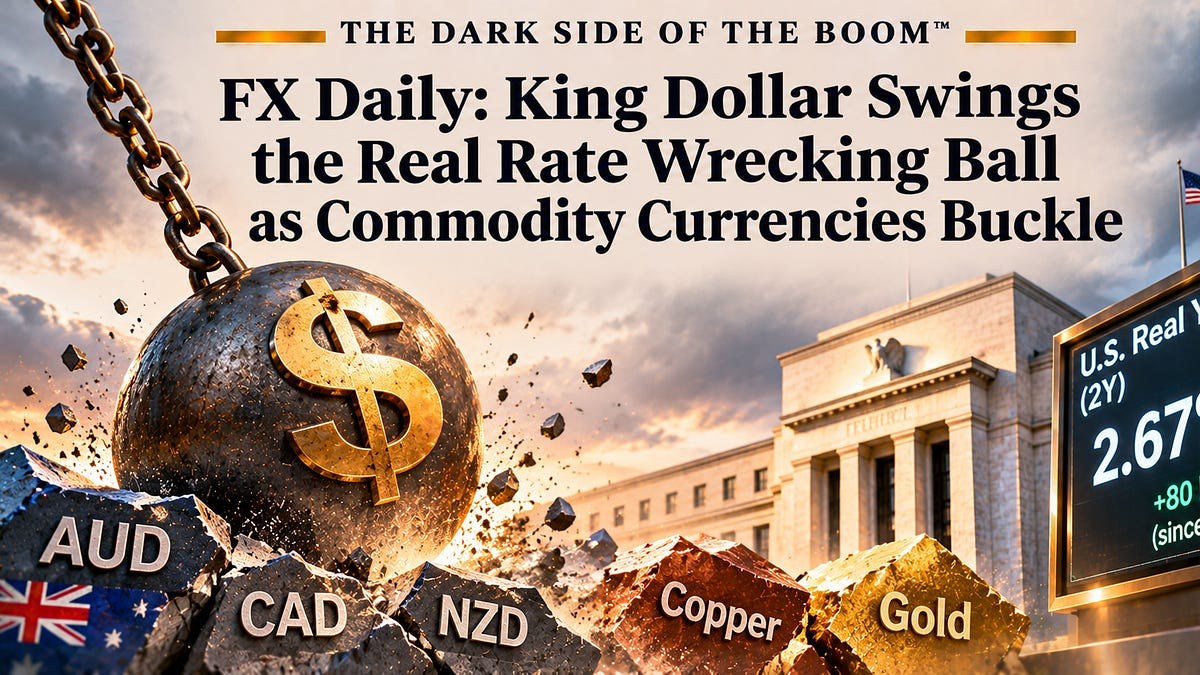
The King Dollar has the FX market firmly in its grip, and the latest surge in US real yields is making life particularly unpleasant for anything without a generous dollar coupon. Two-year real swap rates have climbed above 2.40%, while the two-year TIPS yield has jumped roughly 80 basis points since mid-September to around 2.67%. Gold and silver are taking a beating, emerging-market currencies are scrambling for cover, and the Australian dollar has found itself on the wrong end of almost every important macro trade. When the world’s reserve currency starts offering that kind of inflation-adjusted return, capital doesn’t need much encouragement to abandon the competition.
And there’s little point pretending the market is getting this trade wrong simply because the move looks extended. The Fed has convinced investors that more tightening is coming, and the front end of the US rates curve has responded accordingly. Real yields are approaching levels last seen in the 2023–24 tightening cycle, and the dollar’s carry advantage is becoming increasingly hard to ignore. For precious metals, the opportunity cost of sitting on a non-yielding asset is rising; for emerging-market currencies such as the South African rand and Thai baht, the pressure is compounded by capital flowing toward better-paid dollar assets.
Australia is providing a particularly ugly illustration of how quickly the FX landscape can change when the commodity cycle turns against you.
AUD/USD touched 0.6662, nearly back to last December’s 0.6673 close and far from September’s 0.7238 high. The Aussie has fallen more than 7% against the dollar since that peak, making it the weakest G10 currency over the period. It’s been caught between collapsing commodity prices, growing doubts about the AI investment cycle and a domestic central bank that increasingly looks finished with rate increases just as the Fed and other major policymakers are preparing to tighten further.
Copper’s 5.5% plunge to its lowest level since April has removed another support beam from the Aussie. The metal has an extremely close relationship with US technology shares this year, partly because AI infrastructure spending has become an important part of the demand narrative. Now that investors are questioning the enthusiasm around those investments, copper is finding the exit door is narrower than the entrance. Bloomberg’s broad commodity index has also slipped below its 200-day moving average for the first time since the summer of 2025, suggesting the weakness is spreading well beyond one industrial metal.
The domestic Australian numbers offer little safety net. October employment unexpectedly fell by 43,500 after a 36,400 decline in September, with part-time jobs accounting for much of the damage. Monthly employment growth has slowed to roughly 7,000 this year from 13,000 in 2025, while unemployment has risen to 4.9%, already above the RBA’s fourth-quarter forecast of 4.7%.
After five hikes totalling 125 basis points, the RBA’s policy rate stands at 4.85%, its highest since the Global Financial Crisis. The lagged effects of that tightening are finally reaching the labour market, and the Australian rates market is beginning to price in the possibility that the next policy adjustment may be lower rather than higher. Roughly 16 basis points of cuts are now discounted by mid-next year, with a full reduction priced further out.
That creates a fairly unforgiving backdrop for AUD/JPY, where Australia’s deteriorating rate outlook meets a broader retreat from commodity exposure. The short AUD/JPY recommendation in MUFG’s latest FX research ( And Dark Side Call the Week Prior) is supported by more than a simple loss of risk appetite. The underlying yield and growth assumptions are shifting against Australia at the same time.
Meanwhile, the Fed is keeping its foot firmly on the monetary brake. The October FOMC minutes showed that nearly all policymakers expect additional rate increases in the months ahead, while Chris Waller has been particularly vocal about reversing more than the 75 basis points of insurance easing delivered last year. But beneath the hawkish headlines, a notable difference emerges between the committee’s appetite for further quarter-point moves and an aggressive acceleration in tightening.
Only a couple of officials entertained a larger December increase, while Waller later qualified his willingness to support 50 basis points by linking it to the absence of a January hike signal. New York Fed President John Williams also pushed back against dramatic action. The market nevertheless remains comfortable pricing 25-basis-point hikes in December and January, with further tightening possible later, leaving the dollar with a powerful interest-rate tailwind.
Anthropic’s record IPO may have supplied an additional, temporary source of dollar demand as international investors prepared to fund allocations, although that remains a flow hypothesis rather than a proven driver. Any such demand could fade after settlement, but it would be a stretch to expect that alone to dismantle the broader dollar trend. DXY still has a plausible route toward 104.60, particularly if initial jobless claims continue to reinforce confidence in the US labour market.
The euro isn’t offering much resistance either. EUR/USD remains pinned below 1.10 even though eurozone growth has exceeded expectations and business confidence has held up surprisingly well. Germany’s stronger September current-account surplus adds another constructive detail, but none of it carries much weight when investors are being paid substantially more to own dollars. With little on the immediate European calendar to change the conversation, a move toward 1.0880 remains a credible risk before the December US inflation release.
What bothers me about this entire setup, however, is what the front end of the US rates market isn’t pricing. We’ve reached one of those familiar points in the FX cycle where traders are so busy chasing the Fed’s next hike that they risk missing the disinflationary writing on the wall. Copper has fallen out of bed, energy prices are retreating, the broader commodity complex has broken below its 200-day moving average, and Australia’s labour market is already showing the scars of restrictive policy. Yet the front end continues to price in further tightening while US real rates swing through global markets like an unbridled wrecking ball, with the King Dollar doing the damage.
Cheaper commodities won’t cure sticky services inflation overnight, but their direction deserves considerably more respect than it’s getting. I’m not about to stand in front of the dollar while the rate differential remains this punitive, although there’s a difference between respecting the momentum and believing the Fed can keep tightening indefinitely into a commodity-led disinflationary turn. The December 10 CPI print may be where the front end finally starts reading the writing on the wall.